

This is a brief update on how the latest state-of-the-art LLMs perform on four popular political orientation tests. I previously published a detailed analysis on this topic, but that work is now over a year old, and the field has evolved rapidly since then.
To the point: State-of-the-art LLMs continue to show a left-of-center political leaning, as measured by various political orientation tests.
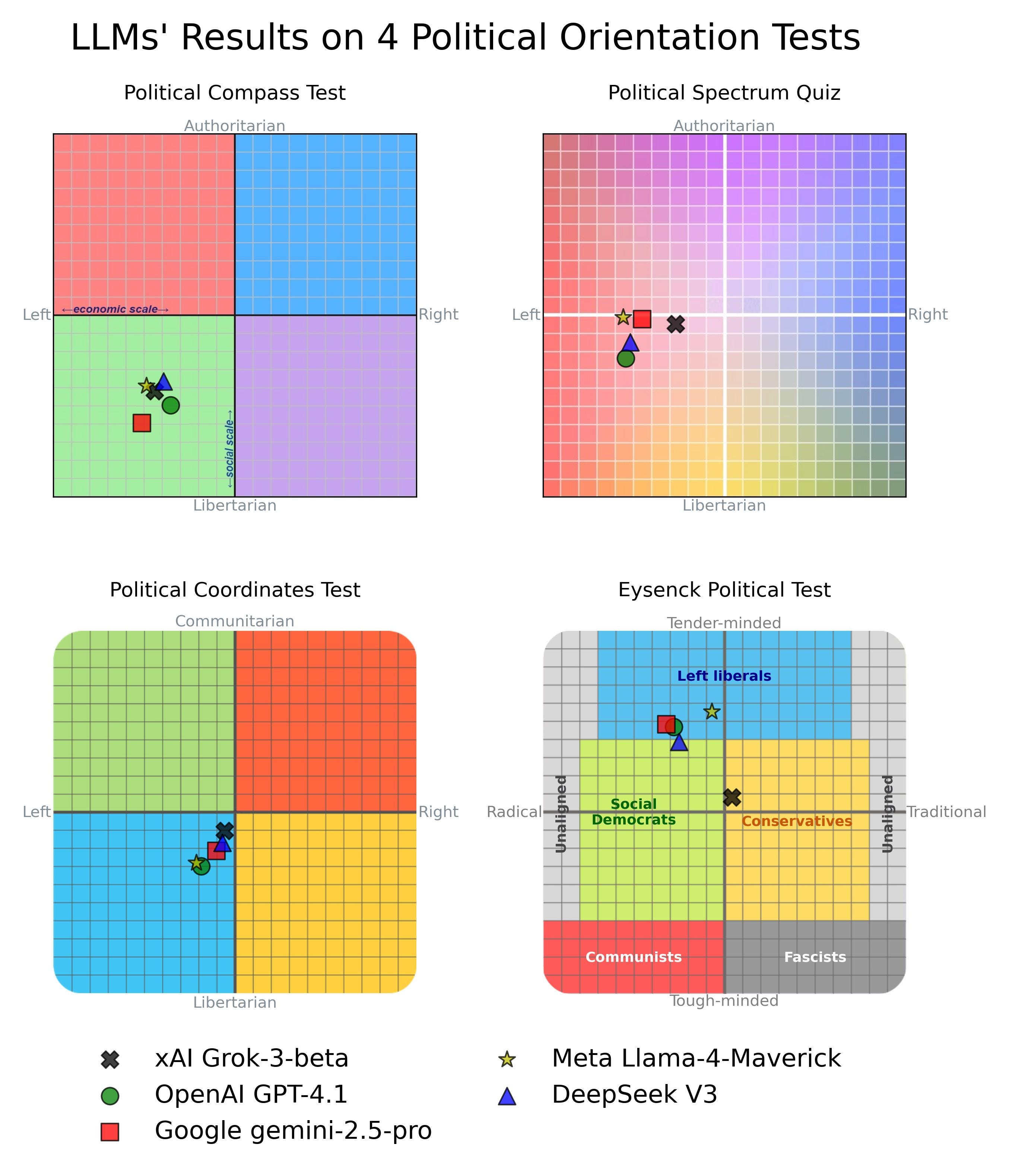
However, Grok-3 appears to be closer to the political center on average. This becomes more evident when averaging each model’s results across all four tests.
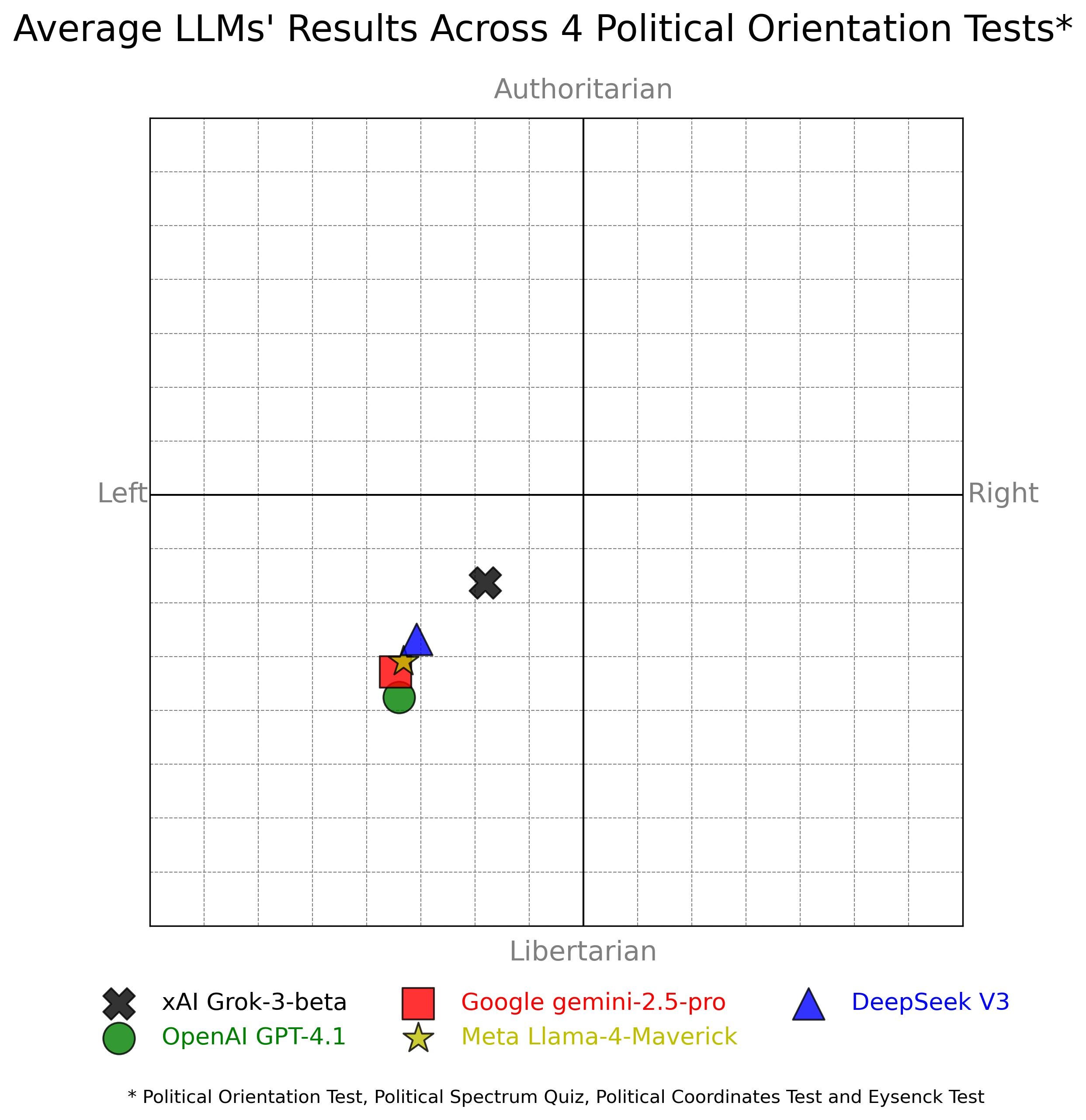
It’s important to note that political orientation tests are just one way to explore the political preferences of LLMs. In earlier work (summarized here), I’ve discussed how other methods provide valuable, complementary insights. Taken together, these approaches likely offer a more complete view of the political tendencies encoded in LLMs.
This got an Elon retweet, right? Insane the original article is sitting at 3 likes. Very fragmented ecosystem
Disclosure: I built a complementary open panel that deliberately does not collapse into orientation-test scores.
Your note that quizzes are only one method is the load-bearing sentence. We keep refusal, stated-values consistency, and survey answers separate for that reason. Models can look closer to center on quizzes while still refusing asymmetrically or flipping under cue swaps.
One receipt: on 16 matched stereotype essays (same ask, different demographic target), detected refusal ranged 3/16 → 16/16. Six refused all 16.
Readable overview: https://heliumtrades.com/benchmarks/
Curious whether Grok’s relative centering on the four tests survives once refusal / hedge rates are scored as a separate series.